Economic Desk
Gasoline output of Persian Gulf Star Refinery hits record
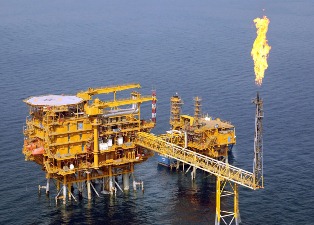
Exports from South Pars, Iran’s hub of energy, have increased 22 percent in the first four-month period of the current Iranian year (March 21-July 22, 2018).
Embracing the world’s largest gas field, South Pars, is also a hub for Iran’s non-oil exports, petrochemicals and gas condensates.
Ahmad Pourheydar, the director general of the Customs Office in Pars Special Economic-Energy Zone, told that nearly $2.6 billion worth of gas condensates (3.92 million tons) have been exported from South Pars, which shows an increase of 14 percent in terms of value compared to last year.
He also said $3.26 billion worth of non-oil products (5.98 million tons) have been exported from South Pars.
Moreover, the exports have soared by 10 percent in terms of weight, and by 29 percent in terms of value, compared to figures of the same period last year, the official said.
Pourheydar noted that in total, exports from South Pars during the four-month period show a 22-percent increase.
The hike comes despite the possible reimposition of US sanctions on Iran.
Gasoline production
Meanwhile, the gasoline production capacity of the Persian Gulf Star Refinery, also known as the Bandar Abbas Gas Condensate Refinery, has reached 26 million liters per day, the plant's CEO said.
Mohammad Ali Dadvar told Shana that by the inauguration of the refinery’s second phase, its gasoline production reached 24 million l/d but another 2 million l/d was added to its production capacity by tapping the spare capacity of the plant’s distillation unit and phase one.
He further said that the hydrogen filtration unit for the third phase of the refinery was being installed and would come on stream within the next month to bring the plant’s daily gasoline production to 30 million liters per day.
The refinery is currently supplying 7 million l/d of gasoil, which will reach 10 to 12 million l/d in the near future, the official added.
Once operating at full tilt, the refinery will supply 36 to 40 million l/d of gasoline. Its premium gasoline output will also be at 27 million l/d from currently 10 million l/d.
The plant is designed in three phases each operating with the nameplate capacity of 12 million l/d of gasoline.
Once the third phase of the plant comes online, Iran would be poised to become a gasoline exporter.
The Persian Gulf Star Refinery is the world’s largest gas condensate refinery which is 70 percent developed by domestically-built equipment, fully installed by Iranian companies, and 95 percent operated by a domestic workforce.