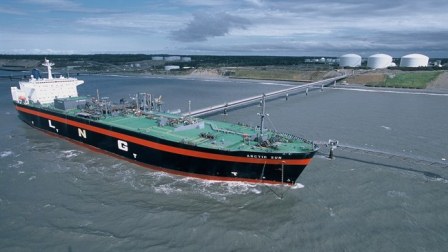
tate-run Korea Gas Corp (KOGAS), the world's second-largest single buyer of liquefied natural gas (LNG), said it plans to import natural gas from Iran as well as explore opportunities to acquire stakes in gas fields in the country.
A KOGAS official said the company was looking to diversify its import sources as supply contracts with Qatar and Oman were set to expire by 2015.
"Iran is rich in natural gas so we would like to work closely with both public and private energy companies there," the official was quoted as saying by Korea Times.
In May 2016, Iran awarded a deal to conduct technical studies on the offshore Balal gas field in the Persian Gulf to KOGAS.
An Iranian official said in June that the country was working on a plan to develop small-size gas liquefaction units with South Korean companies, including KOGAS.
Saeed Pakseresht, director for research and development affairs of the National Iranian Oil Company (NIGC), was quoted as saying that a consortium from Iran and another from South Korea, including Oceanus and KOGAS, would be involved in the scheme.
"We do not have the technology to develop mini-LNG plants, but joining hands with companies such as Oceanus consortium and KOGAS is an important first step to develop our LNG sector," he said.
Korean companies are also expanding involvement in Iran's massive oil sector. Last month, South Korea's SK Engineering and Construction Co (SKEC) signed heads of agreement for a €1.6 billion upgrade of Tabriz refinery.
A separate $2 billion contract is about to be signed with South Korea's Daelim company to boost oil processing capacity at Isfahan refinery, according to Abbas Kazemi, who is Iran's deputy oil minister.
South Korea's imports of Iranian crude oil increased 40.2 percent in August from the same month a year earlier, Reuters reported on Friday, citing customs data.
The Asian country is a major client of Iran's condensate, an ultra-light high quality oil. According to the Reuters report, South Korea imported 12.22 million tons, or 368,529 bpd, of oil from Iran in the first eight months of 2017 — up 46.7 percent from 8.33 million tons during the same period the year before.
Meanwhile, Royal Dutch Shell said it is preparing to bid for development of Iran's giant Azadegan field after putting an end to a century of oil production in neighboring Iraq.
Shell has submitted the results of its feasibility studies on South Azadegan and Yadavaran fields to National Iranian Oil Company (NIOC), Shana reported.
Both fields lie across the Iraqi border in Iran's strategic West Karoun oil cluster. Shell signed a basic agreement with NIOC in December 2016 to study the investment potentials in South Azadegan and Yadavaran as well as Kish gas field.
South Azadegan, discovered in 2001, has recoverable reserves of about two billion barrels. It is believed to be connected with Iraq's Majnoon field from which Shell has decided to withdraw.
The decision announced by Shell on Wednesday came after long-running talks on a planned output expansion from current levels of 220,000 barrels per day appeared to founder.
The Anglo-Dutch firm said it had agreed with Iraq's oil ministry to relinquish operations at Majnoon field to the government after unfavorable changes to fiscal terms.
Shell is also selling its 20 percent stake in West Qurna 1 oilfield in southern Iraq which is operated by Exxon Mobil.